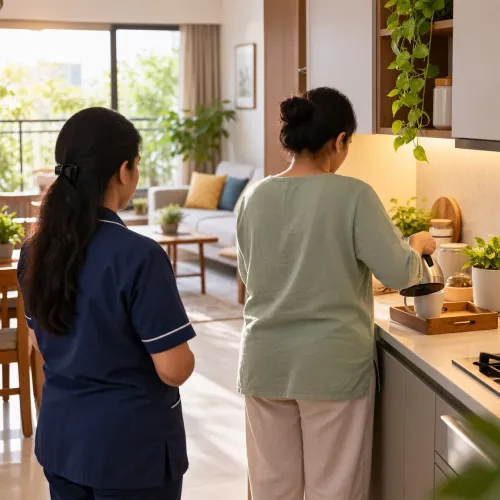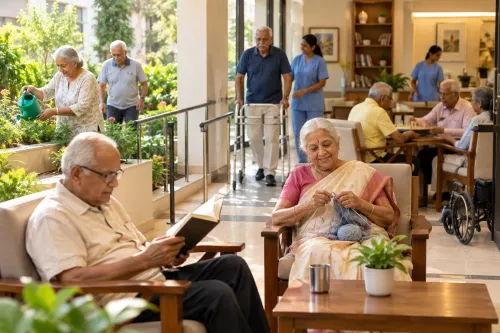


The phrase “care center” can describe anything from independent senior housing to a nursing home with round-the-clock clinical care. You will be able to identify the level of support a senior needs, compare facility and home-care options, and test a Pune provider’s staffing, safety, fees, and emergency arrangements before making a decision.
Key takeaways
- Match supervision, mobility, and medical needs to the facility’s care level.
- Ask for staffing numbers, clinical coverage, and hospital-transfer procedures.
- Compare a Pune care center with the senior’s actual support needs at home.
- Inspect rooms, bathrooms, medicines, emergency plans, and admission documents.
What kind of senior care facility are you actually considering?
Choose the setting by the senior’s daily needs, not by a signboard calling itself a care center in Pune.
| Option | Ordinary day |
|---|---|
| Independent living centre | Private accommodation, meals, housekeeping, activities and companionship; the resident manages bathing, dressing, medicines and mobility. |
| Residential old-age home | Shared or private accommodation, meals, basic supervision and companionship; personal-care help varies by facility. |
| Assisted living | Staff help with bathing, dressing, toileting, eating, walking, transfers and medication reminders. |
| Nursing home | Skilled nurses provide clinical observation, medicines, wound care, injections, catheter care and escalation to doctors. |
| Memory-care facility | Secure accommodation, meals, dementia supervision, wandering controls, structured activities and behaviour support. |
| Day-care centre | Short-term daytime supervision, meals, activities and sometimes physiotherapy; no overnight accommodation. |
| Home-care agency | Caregivers or nurses visit the senior’s home for personal care, medication support or nursing tasks. |
| Rehabilitation centre | Time-limited physiotherapy, gait training, strength work and recovery after illness, injury or surgery. |
| Hospice service | Comfort-focused care for advanced illness, including symptom relief and family support rather than curative treatment. |
Ask whether the residence is an old-age home, assisted-living service or registered nursing home. “Care center in Pune” is not a clinical or regulatory category, and an elder-care signboard does not prove licensing. A residence providing nursing or medical treatment may require registration under Maharashtra’s nursing-home framework; accommodation with non-clinical support follows a different model.
The Maintenance and Welfare of Parents and Senior Citizens Act, 2007, provides for at least one old-age home in each district for indigent seniors, with a prescribed capacity of at least 150 residents. It does not make every private senior citizen care center in Pune government-run or subsidised.
- Which activities of daily living are supported?
- Is a registered nurse present overnight?
- What registration category and emergency process apply?
Match the senior’s daily needs to the right level of care
Choose care by the task the senior cannot complete safely, not by a label such as “dependent.” Record bathing, dressing, toileting, eating, walking, and transfers separately; help with bathing is not the same staffing need as a two-person transfer.
| Option | Daily fit | When it applies |
|---|---|---|
| Independent living | Manages personal care and medication; wants meals, companionship, and safer surroundings | The senior remains physically and cognitively safe without hands-on care |
| Assisted living | Needs hands-on help with selected activities of daily living | Staff can support bathing, dressing, toileting, eating, walking, or transfers |
| Nursing care | Needs skilled clinical treatment and frequent monitoring | Wound care, injections, catheter care, complex medication administration, or close observation |
| Dementia supervision | Needs secured routines and behaviour oversight | Wandering controls, night-time agitation support, medication-error prevention, consent review, and behaviour management |
A dementia-capable care center for seniors in Pune must explain how it prevents wandering, responds to unsafe behaviour, protects residents from abuse, and handles a person who cannot give informed consent. A general residence may accept dementia without having secure doors, trained staff, or a behaviour-management process.
Before admission for elderly care in Pune, request a written assessment covering:
- Previous falls, gait, balance, vision, footwear, lighting, floor transitions, and toilet access
- Lying and standing blood pressure, sedating medicines, continence, and nutrition
- Transfer safety, including whether one or two staff members are needed and what equipment they use
If these answers are vague, the proposed care level is not established.
Check staffing, clinical coverage, and hospital-transfer support
Overnight presence does not equal clinical coverage: a 24-hour caretaker provides personal care and transfers, a 24-hour nurse provides clinical observation and treatment, while 24-hour clinical supervision means qualified clinical staff can assess deterioration and escalate it on every shift.
1. Ask who is physically present overnight at the senior citizen care center in Pune. Identify who responds to a fall, breathlessness, delirium, hypoglycaemia, or a medication error, and how quickly that person can call an ambulance and arrange hospital transfer.
2. Verify each role: trained caregivers for bathing, toileting, mobility, and transfers; registered nurses for observation, medication administration, wound care, and escalation; visiting doctors for reviews and prescribing; physiotherapists for strength, gait, balance, and rehabilitation; and counsellors for adjustment, grief, family communication, and dementia-related distress.
3. Ask who stores and administers medicines, including insulin and anticoagulants. Require records for missed or refused doses, and confirm that a doctor reconciles the complete medication list after admission and every hospital discharge.
4. Treat a hospital “tie-up” as a referral arrangement, not emergency cover. Get the named receiving hospital, ambulance process, consent procedure, family notification steps, accompanying-staff plan, and confirmation that clinical records and the current medication list travel with the resident.
5. For dementia, check wandering controls, night-time agitation procedures, medication-error reporting, abuse safeguards, and consent arrangements. A care center in Pune may accept dementia residents without secure design or trained behavioural support, so request its written admission and escalation policy.
Compare a Pune care center with care delivered at home
Home care suits a medically stable senior when the house has safe toilet access, suitable sleeping arrangements, and reliable attendants or nurses whom the family can fund and supervise.
| Option | Supervision and staffing | Privacy, family, transport, and social contact | Physical setting |
|---|---|---|---|
| Home care | You control the roster, but overnight observation, wound care, medication administration, and two-person transfers require specifically trained staff. | Maximum privacy and family involvement; transport to hospital, tests, and physiotherapy must be arranged separately. Social contact depends on visitors and activities outside the home. | Provide a clear route to the toilet, non-slip flooring, adequate lighting, grab bars, and enough space for a walker or wheelchair. |
| Care center for seniors in Pune | Staff are nearby, but confirm whether overnight cover means a caretaker, registered nurse, or clinical supervision. Ask who responds to falls, delirium, breathlessness, hypoglycaemia, and medication errors. | Less privacy, structured family visits, easier shared transport and social contact; verify ambulance arrangements and the named receiving hospital. | Inspect bedrooms, bathrooms, lift access, call bells, ramps, and evacuation routes rather than trusting a general description. |
Home care becomes unsuitable when the senior wanders, falls repeatedly, needs two-person transfers, requires overnight observation, has uncontrolled symptoms, or needs clinical management beyond available staff. A facility may be unsuitable for hospital-level treatment, unsafe behaviour it cannot manage, or admission refused without a lawful, workable consent plan.
Request a written tariff covering deposits, higher-dependency charges, incontinence supplies, medicines, tests, ambulance transport, physiotherapy, attendants, electricity, and hospital costs. Compare both current and next-level care. For elderly care in Pune, use these questions when assessing Abhalmaya Oldage Home in Pune or any care center.
Related services
Independent Living Centre in Pune Independent Living Centre in Pune Abhalmaya Oldage Home – Independent Living in Pune Abhalmaya Oldage Home offers safe, comfortable, and supportive independent living services in Pune... View service → |
Old Age Home in Pune # Old Age Home in Pune – Aabhalmaya Oldage Home Aabhalmaya Oldage Home provides compassionate and supportive **old age home services in Pune** for... View service → |
Use this inspection checklist before admission
Inspect the senior citizen care center in Pune at two different times, not only during a polished daytime tour. Use this checklist:
1. During a walkthrough, check cleanliness, persistent odour, ventilation, daylight, night lighting, floor transitions, wet surfaces, loose wires, bed height, wheelchair turning space, bathroom grab bars, non-slip flooring, ramps, lift access, call bells, fire exits, extinguishers, evacuation routes, generator or other backup power, and accessible toilets and dining areas.
2. Visit during a meal. Watch food hygiene, resident positioning, dining access, assistance with eating, noise, and whether staff respond promptly. If possible, visit after dark to observe night staffing, toilet response times, residents left in beds or chairs, lighting, lift operation, and generator operation.
3. Ask for the admission assessment, individual care plan, fee schedule, deposit and refund terms, medication chart, consent process, visiting rules, complaint route, discharge terms, and hospital-transfer procedure.
4. Request written policies for falls, missing residents, outbreaks, pressure injuries, medication incidents, and death. Ask to see a blank incident form or anonymised incident summary.
5. Ask who handles a night-time fall, breathlessness, delirium, hypoglycaemia, or medication error, and how transfer occurs. Confirm the named hospital, ambulance, accompanying staff, consent, communication, and records sent with the resident.
6. For dementia, verify wandering controls, night supervision, abuse prevention, and consent procedures. Consider a trial stay when the care center in Pune permits one.
Frequently asked questions
What kind of senior care facility should you choose in Pune?
Choose between independent living, assisted living, nursing care, and memory care based on supervision, mobility, and medical needs.
How do you match a senior’s needs to the right care level?
List daily tasks such as bathing, dressing, walking, medicines, meals, and toileting, then ask which tasks staff provide and how often.
What should you check about staffing and hospital support?
Ask for staff coverage by shift, clinical availability, emergency response steps, ambulance arrangements, and the process for hospital transfers.
How does a care center compare with care at home?
Compare supervision, companionship, safety modifications, family availability, travel time, and the complexity of arranging separate home-care services.
What should you inspect before admitting a senior?
Inspect bedrooms, bathrooms, handrails, call bells, cleanliness, food service, medicine storage, emergency exits, visitor rules, fees, and admission documents.
Related service
Elderly Care & Senior Citizen Assistance Elderly Care & Senior Citizen Assistance Abhalmaya Oldage Home **A Safe, Caring & Comfortable Home for Senior Citizens** At **Abhalmaya Oldage Home**, we provide compassionate care, dignity,... View service → |