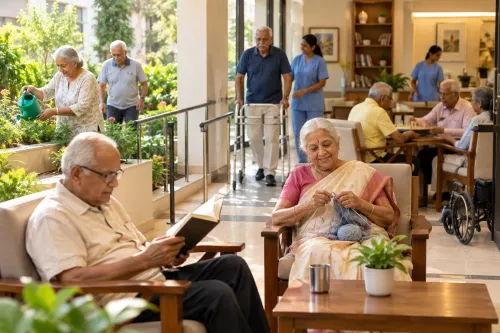

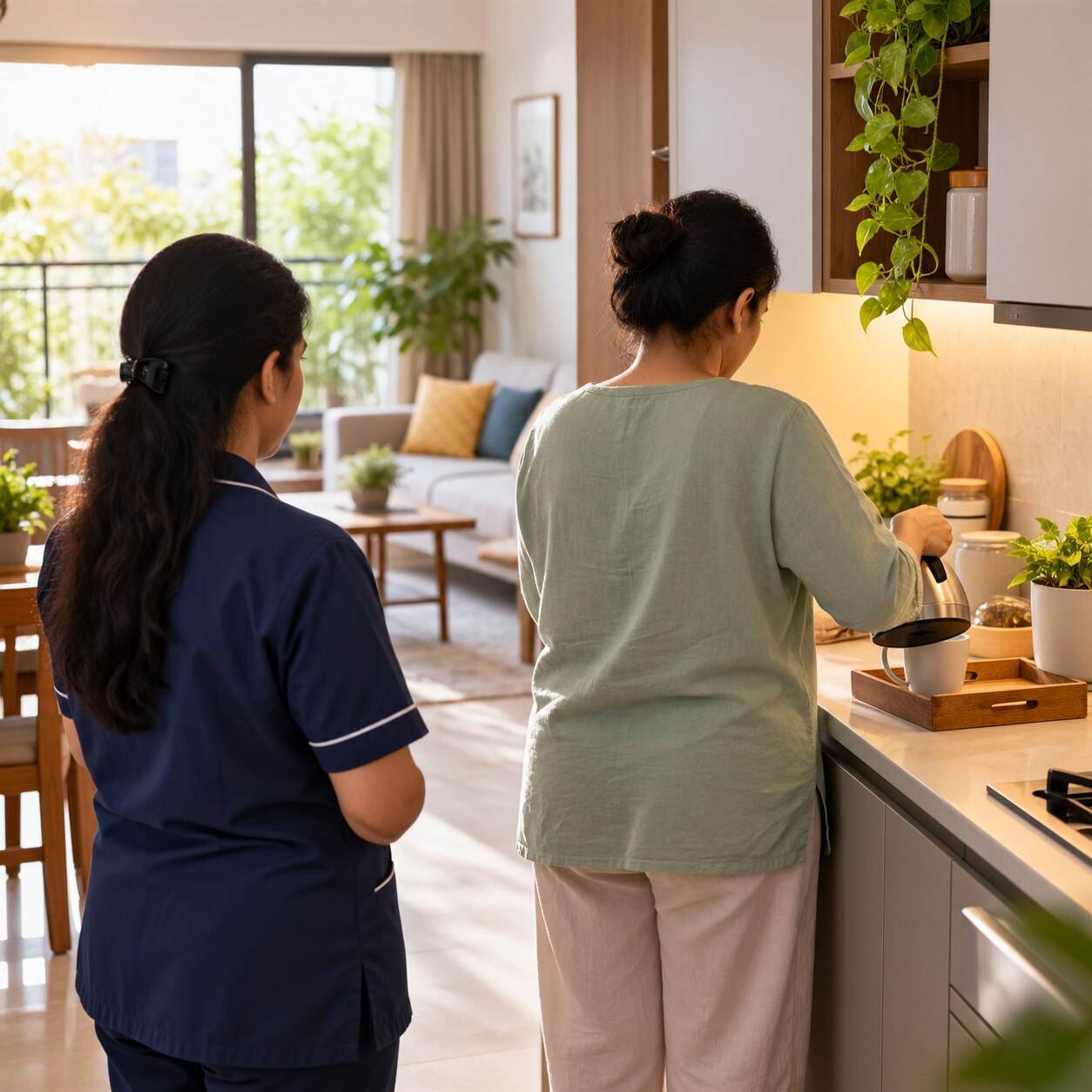
The right placement depends on safety, clinical needs and the older adult’s ability to manage everyday life—not on whether a diagnosis appears in their medical record. By the end, you will be able to separate independent living from psychiatric admission, identify urgent warning signs and compare Pune residences using practical questions.
Key takeaways
- Choose independent living only when medical and psychiatric stability is documented.
- Seek urgent assessment for suicidal intent, delirium, violence, or dangerous hallucinations.
- Ask the doctor to review medicines, mobility, cognition, and daily-care needs before relocation.
- Compare staffing, emergency procedures, medication support, and hospital access before choosing a centre.
What is the difference between independent living and psychiatric hospital treatment?
Independent living is housing with meals, social opportunities and a defined level of domestic or personal support for a resident who remains medically and psychiatrically stable. Assisted living adds help with bathing, dressing, toileting, transfers or medication routines.
Residential elderly care may provide more hands-on care and supervision, but staffing and clinical services differ between Pune facilities.
| Option | What it provides | When it applies |
|---|---|---|
| Independent living | Housing, meals, companionship and limited support | The resident is stable and can manage daily life with available help |
| Assisted living | Personal-care and medication-routine assistance | The resident needs regular help with daily activities |
| Residential elderly care | More supervision and hands-on care | Physical or cognitive needs exceed ordinary independent living |
| Psychiatric hospital | Assessment, observation, medication changes and crisis treatment | Acute or severe mental illness creates immediate safety or functional concerns |
A psychiatric diagnosis does not automatically require hospital admission. A mental hospital in Pune treats acute risk or severe symptoms; it is not automatically a long-term home. Under the Mental Healthcare Act, 2017, treatment must protect dignity, confidentiality and the least restrictive environment, with statutory safeguards for admission.
Do not rely on a residence’s label. Ask for its written admission criteria and service list, including medication administration, night supervision and emergency transfers. The independent living or mental hospital in Pune decision should start with current risk and functioning, not family fear or the diagnosis name.
When is independent living the safer and more suitable choice?
Choose independent living when the older adult is medically stable, can make day-to-day decisions, and has no immediate plan or intent to harm themselves or another person. The person must also participate safely in daily activities, independently or with help the residence explicitly provides.
That includes eating, drinking, communicating, moving around, bathing, toileting and dressing. Confirm the medication routine before admission: who stores medicines, gives each dose, records administration and contacts the doctor after a missed or refused dose.
Stable depression, anxiety, a treated psychotic disorder or a past psychiatric admission does not by itself rule out a retirement home in Pune. Independent living can suit someone who needs regular meals, companionship, transport, exercise, domestic help or a predictable routine instead of continuous clinical supervision.
| Setting | Suitable when | Poor fit when |
|---|---|---|
| Independent living | The resident manages basic activities with defined support | Staff cannot respond to falls, wandering or personal-care needs |
| Assisted living | The resident needs help with bathing, dressing, toileting, transfers or medicines | The required help exceeds the residence’s staffing or equipment |
| Memory care or skilled nursing | Dementia, substantial physical care or 24-hour supervision requires a specialist setting | The person needs acute psychiatric stabilisation |
| Psychiatric hospital | Suicide risk, violence, severe psychosis, mania or unsafe confusion requires urgent treatment | Symptoms are stable and the main needs are companionship or routine |
Do not choose ordinary independent living if the residence cannot manage incontinence, aggression, night-time disorientation, repeated falls or physical assistance. Compare supervised residential elderly care, assisted living, memory care and skilled nursing instead.
Which warning signs require urgent psychiatric or medical assessment?
Contact emergency services or obtain an urgent psychiatric assessment for suicidal intent, a recent serious attempt, a credible threat to another person, severe psychosis, uncontrolled mania, extreme agitation, or an inability to eat, drink, or remain safe because of mental illness.
Do not move the person into an old age home in Pune while these problems are unsettled.
| Situation | Appropriate response | Why |
|---|---|---|
| Immediate psychiatric danger | Emergency services or psychiatric hospital | Acute stabilisation and supervised treatment |
| Sudden confusion or drowsiness | Prompt medical assessment | Infection, dehydration, pain, medication effects, low blood sugar, or another metabolic problem may cause delirium |
| Crisis resolved, but basic care remains unsafe | Supervised residential care | Ordinary independent living cannot provide continuous oversight |
Sudden confusion, drowsiness, hallucinations, a sharp behaviour change, or sudden loss of function is a medical warning, not proof of dementia or psychiatric illness. A doctor must assess possible delirium promptly, especially after an infection, medication change, poor fluid intake, or a fall.
A psychiatric hospital is appropriate when risk or symptoms cannot be managed safely at home, but it is not automatically a long-term home after stabilisation. Before discharge, request a written plan covering medicines, follow-up appointments, warning signs, family duties, and the required level of supervision.
If the crisis has passed but the person cannot manage eating, drinking, toileting, medicines, or personal safety, choose supervised residential care rather than ordinary independent living.
What assessment should happen before relocation?
Arrange a clinical assessment before signing an admission agreement. Use a psychiatrist, geriatrician, primary-care doctor or clinical psychologist who can assess the person’s current condition rather than rely on a diagnosis or old certificate.
1. Ask the clinician to document the diagnosis, current symptoms, suicide and violence risk, decision-making ability, cognition, delirium risk, sleep, substance or alcohol withdrawal risk, and capacity to consent to relocation.
2. Review every medicine, including insulin, anticoagulants, seizure medicines, and drugs requiring blood tests or dose monitoring. Confirm who will prescribe, administer and monitor each one.
3. Test practical function: bathing, toileting, dressing, eating, transfers, walking, communication, continence, call-bell use and safe medication handling.
4. Record falls, wandering, night-time confusion and aggression. State whether the person needs assistance from one person or two.
5. Require a clear recommendation: independent living, assisted living, memory care, skilled nursing, outpatient psychiatric care or hospital admission.
6. Repeat the assessment after a hospital stay or medication change. Do not use an old certificate to justify relocation.
Relocation does not treat untreated psychosis, severe depression, delirium or withdrawal. If the person can live safely with support but feels lonely or struggles with routines, structured activities, meals, exercise, transport and regular family contact may help more than psychiatric admission. Those services cannot compensate for acute symptoms, high suicide risk or substantial physical-care needs.
How should you compare an independent living centre in Pune with a mental hospital?
Visit the residence and obtain written answers before comparing it with a mental hospital in Pune. The label “independent” proves nothing about clinical coverage, personal care or emergencies.
| Option | Best fit | Confirm before choosing |
|---|---|---|
| Independent living centre in Pune | Stable resident who manages basic activities with stated support | Staffing, medicines, falls and emergency transfer |
| Assisted or supervised care | Resident needing personal care or close monitoring | Dementia, wandering, continence and night supervision |
| Mental hospital | Acute psychiatric risk or severe symptoms | Psychiatrist access, observation, treatment and discharge plan |
Ask these questions on site:
- Who is present overnight? Is a registered nurse available? How fast do staff respond to a fall? Who arranges ambulance transport and hospital transfers, and which doctor or visiting psychiatrist reviews residents?
- Who stores, administers and records medicines? What happens after a missed or refused dose? Are insulin, anticoagulants and seizure medicines accepted?
- What equipment prevents falls? Can two staff provide transfers? How are continence care, dementia, wandering, aggression, night-time supervision, behavioural support and physiotherapy handled? Ask for fire-evacuation and generator-backup procedures.
- What minimum ability is required for bathing, toileting, eating, mobility, communication and using an emergency call system?
Ask how families receive updates, join care-plan meetings and respond to deterioration, hospitalisation or discharge. Compare peak-traffic travel from Anand Nagar or Niranjan Park, ambulance access and distance from the treating doctor. Abhalmaya Oldage Home should be assessed by these answers, not its appearance.
Choose an independent living centre in Pune only when actual staffing matches the clinical assessment.
Related services
Independent Living Centre in Pune Independent Living Centre in Pune Abhalmaya Oldage Home – Independent Living in Pune Abhalmaya Oldage Home offers safe, comfortable, and supportive independent living services in Pune... View service → |
Old Age Home in Pune # Old Age Home in Pune – Aabhalmaya Oldage Home Aabhalmaya Oldage Home provides compassionate and supportive **old age home services in Pune** for... View service → |
Frequently asked questions
What is the difference between independent living and psychiatric hospital treatment?
Independent living provides housing, meals, companionship, and defined daily support for a medically and psychiatrically stable resident. Psychiatric hospitals provide assessment, treatment, monitoring, and crisis care for acute mental-health symptoms.
When is independent living safer than psychiatric hospital treatment?
It is suitable when the person is stable, not at immediate risk, can follow a medication plan, and needs housing or daily support rather than intensive psychiatric treatment.
Which warning signs require urgent psychiatric or medical assessment?
Seek urgent help for suicidal plans, threats or acts of violence, severe confusion or sudden personality change, dangerous hallucinations, inability to eat or drink, or withdrawal from essential medicines.
What assessment should happen before relocation?
Arrange a clinician-led review of diagnosis, recent symptoms, medicines, cognition, mobility, continence, sleep, substance use, self-care, and emergency contacts before moving.
How should you compare an independent living centre in Pune with a mental hospital?
Compare the centre's staffing, medication assistance, overnight supervision, emergency response, hospital access, admission criteria, fees, resident routines, and family communication process.
Related service
Elderly Care & Senior Citizen Assistance Elderly Care & Senior Citizen Assistance Abhalmaya Oldage Home **A Safe, Caring & Comfortable Home for Senior Citizens** At **Abhalmaya Oldage Home**, we provide compassionate care, dignity,... View service → |